From a storied, historic past, to a dynamic present, West Virginia State University (WVSU) continues its legacy of preeminent distinction as a historically black college/ university (HBCU), 1890 land-grant research institution, that has evolved into a fully-accessible, diverse and inclusive masters degree granting institution. Consistent with its tradition, West Virginia State enrolls a wide range of students and assists them in achieving their academic, civic, and career potential through quality academic programs in an environment nationally heralded as a “living laboratory of human relations.” West Virginia State University is the largest institution of higher education in the Charleston metropolitan area and offers a wide range of academic and experiential opportunities.
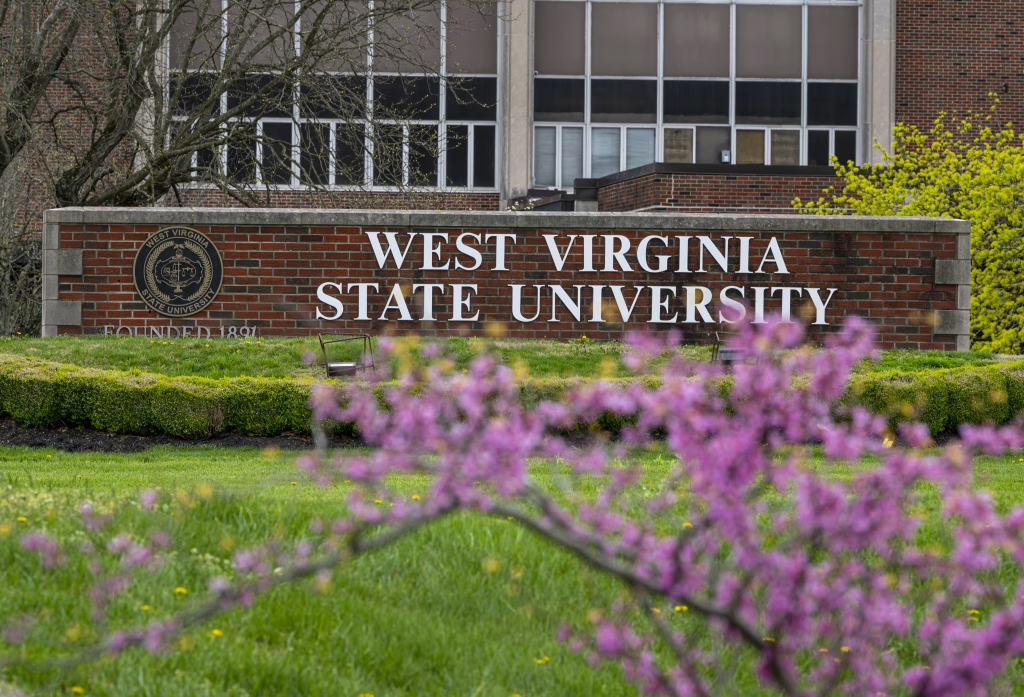
 WVSU Almanac
| Image | Type | Counter | Link |
|---|---|---|---|
| pdf | 21 |
History & Location
Founded 1891: Originally founded as the West Virginia Colored Institute, West Virginia State University was designated by the United States Congress as one of the original 1890 land-grant schools under the Second Morrill Act.
Name Changes:
- 1915, West Virginia Collegiate Institute
- 1929, West Virginia State College
- 2004, West Virginia State University
Land-Grant
- An 1890 Land-Grant Institution
- One of only 19 land-grant universities designated by the Second Morrill Act in 1890
- One of only two land-grant institutions in West Virginia
- Land-Grant Extension services aid more than +20,000 West Virginians in 38 counties throughout West Virginia
Campus
- Located in Institute, W.Va., approximately 8 miles from Charleston
- Approximately 123-acre campus, 864,287 square-feet of floor space
- Centrally located within one of West Virginia’s largest population centers
Details
- University Accreditation: Higher Learning Commission
- 2025 Annual Headcount Enrollment: 3,570
- Student/Faculty Ratio: 16:1
- Research Funding: $17M Annually
- Financial Aid: 83% financial aid participation rate
Undergraduate Student Profile (2025)
- Female 58%
- In-State 89%
- Adult (25+) 9%
- Minority 15%
- Part-time 61%
- Transfer 5%
- International 2%
Academics
Academic Colleges
- College of Arts, Humanities, and Public Affairs
- College of Business, Sciences, and Technology
- College of Education, Health, and Social Sciences
Undergraduate Degrees
- Art
- Biology*
- Business Administration*
- Chemistry*
- Communications*
- Computer Science
- Criminal Justice
- Cybersecurity*
- Economics*
- Education (Elementary and Secondary)
- Engineering
- English
- Health Science
- History
- Interdisciplinary Studies
- Mathematics
- Music Performance
- Nursing
- Political Science
- Psychology
- Regents Bachelor of Arts
- Social Work
- Sports Studies
Graduate Degrees
- Biotechnology
- Criminal Justice Administration
- Computer Science
- Instructional Leadership
- Public Administration
- Sports Studies
Doctorate Degree
- Leadership Studies (Ed.D.)
* Indicates Agriculture Studies options available
Programs Offered 2023-2024 Academic Year:
- 24 Baccalaureate Degree Programs
- 7 Master’s Degree Programs
- 1 Doctoral Degree Program
- 10 Fully Online Programs
Retention & Graduation
Retention and Graduation
- Fall to fall FTF retention rate is 58% (2025 cohort)
- 4-year graduation rate is 26% (2019 cohort)
- 6-year graduation rate is 38% (2019 cohort)
Reference:WV HEPC Almanac 2025
Alumni: 69% of alumni, within six months of graduation, are employed full-time, attend graduate/professional school full-time, or serve in the military full-time. Reference: Career Services, May 2022 graduation cohort
Workforce Outcomes (2020 Graduates)
- 72% Working in West Virginia two years after graduation
- 67% Working in West Virginia four years after graduation
- Median wages bachelor’s degree $40,105 two years after graduation and $48,699 four years after graduation
- Median wages master’s degree $49,659 two years after graduation and $55,991 four years after graduation
Reference: WV HEPC Almanac 2025
Licensure Pass Rates
Praxis Pass Rates (Education):
2025
Core Math: 37.50%
Elementary Science: 80%
Elementary Ed MS Math: 50%
Elementary Ed MS Reading: 80%
Elementary Ed MS Science: 50%
Elementary Ed MS Social Studies: 55.56%
Education Leadership Admin and Supervision: 100%
2024
Core Reading: 90%
Elementary Ed CKT Social Studies: 60%
Elementary Ed MS Math: 72.73%
Elementary Ed MS Reading: 77.78%
Elementary Ed MS Science: 62.50%
Elementary Ed MS Social Studies: 50%
NCLEX First Time Pass Rates (Nursing):
2025 91.6%
2024 94%
ASWB Exam First Time Pass Rates (Social Work):
2025
Bachelors-40%
Masters-83%
Advanced Generalist-100%
Athletics
- National Affiliation: NCAA Division II
- Conference Affiliation: Mountain East Athletic Conference
- Men’s Sports: baseball, basketball, cross country, football, golf, tennis, and track & field
- Women’s Sports: acrobatics & tumbling, basketball, cross country, soccer, softball, tennis, track & field, and volleyball
- Spirit Groups: Cheerleading, Dance Team
- Athletic Colors: Old Gold and Black
- Mascot: Yellow Jacket named Stinger